Spanish Philippines Revenues and Aguinaldo Revolutionary Stamps 1860-1899.
Updated: Sep 1
Blog Update September 1, 2026.
Aguinaldo revolutionary government 1899 -1899, Telegraph stamps.
For the complete collection, click here


1898, correo y telegrafos, revo;utionary period. Sold on eBay for $68

Philippines telegraph stamps issued by the revolutionary government in 1898. The (favor) cancellation shows communicaciones Filipinas Tuguegarao. Tuguegarao is a city in the Cagayan province. On August 31, 1898, the Philippine revolutionary forces took over the city from the Spanish. However the independence was short lived, on December 12, 1899 the city was occupied by American troops.
Spanish Philippines Telegraph stamps.
An online catalog for Philippines telegraph stamps is posted on the homepage of my website. access via Spanish Philippines Telegraph Stamp Catalog 1872-1898. By Steve Panting at www.telstamps.org.uk
Telegram receipt from Manila to Hongkong. August 24, 1881/ 3 words for 1 pesos and 52 centimos. Paid for by a mixture of telegraph and postage stamps.

Telegram receipt from Manilla to Singapore February 21, 1885. 9 words (Palabras} for 21 pesos and 11 centimos. Paid for by a mixture of telegraph stamps and postage stamps.

Spanish Philippines telegram receipt 1882. Telegram to Singapore from the Philippine city of Cavite. Three Derechos de Firma revenue stamps plus 3 postal stamps were used as telegraph stamps.
Revenue stamps were used for telegraph and postal uses, and postal and telegraph stamps, sometimes surcharged, were used for revenue purposes. All stamps on the receipt cancelled by punch holes. Sold on eBay for $78.

Spanish Philippines Derechos de Firma, Fees for official signatures on Telegram receipt from Manilla to Boston USA. dated 29 January 1881. 52 pesos and 21 centimor for 16 words.

Blog Update August 4, 2026.
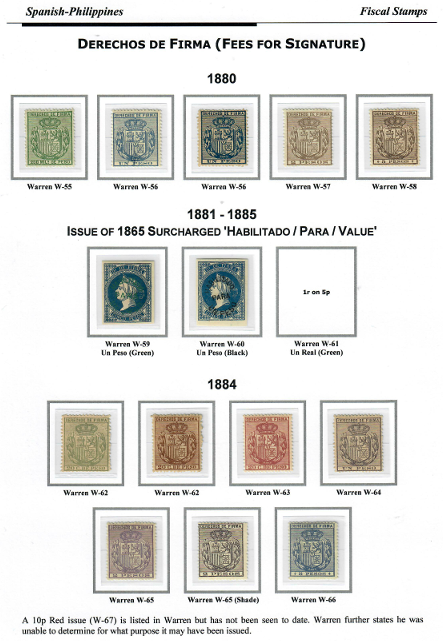
Now the complete chapter on Derechos de Firma is posted. Thanks to Nigel Gooding to let me use his collection. you can also view Nigel's collection at Philippine Fiscal Stamps
Spanish Philippines Derechos de Firma, Fees for official signatures 1864-1867.

Spanish Philippines telegram receipt 1882. Telegram to Singapore from the Philippine city of
Spanish Philippines Derechos de Firma, Fees for official signatures 1869 issue. Previously issued stamps overprinted Habilitado por la Nacion.




Spanish Philippines Telegraph stamps surcharged as revenue stamps for Recargo de Consumes, or consumer tax in 1888. Used as postage stamps on a cover to the Antique province, located in the Western Visayas region. I paid $25 in auction for this interesting item.
However, Nigel Gooding in the UK found after the auction a certificate, picture 2 on this same item stating it was fake. Translation of certificate in picture 3. So, looking nice and being cheap should raise suspicion before I did put the bid in.

Blog Update February 3, 2026.
Papel Sellado from the Spanish Philippines 1901 under US administration.

Spanish Philippines Papel Sellado with a 10 centavos 1898 design Timbre Movil or Documentary stamp. Overprinted in 1901 with a boxed handstamp reading: US Military Government, 1901, Internal Revenue in blue color. The document is A4 size but not completely shown in the picture.

Similar document as above, used with a 15 centavos Timbre Movil or Documentary stamp overprinted in 1901 for use by the US Administration.
Papel Sellado Pagos al Estado under US administration, 1901.
"Pagos al Estado" (Spanish for "Payments to the State") signifies that the stamp represents payment of a specific fee or tax owed directly to the government, often for official documents or licenses, such as fees for passports or other permits during the Spanish colonial era, showing the transaction was settled with the colonial administration for state revenue.

Spanish Philippines Papel Sellado with a 10 centavos Pago al Estado printed stamp.
Overprinted with a boxed handstamp reading: US Military Government, 1901, Internal Revenue in blue color. The top part superior was supposed to be given to the interested party. The inferior part was supposed to be attached to the case file.
In the Philippines, Pago al Estado stamps were never issued as separate stamps,

Same as the document above but with a 15 centavos Pagos al Estado overprinted for use by the US Administration.
Papel Sellado Pagos al Estado under US administration. 1902.

Even 4 years after the take-over of the Philippines by the US, Spanish issued Papel Sellado, revenue stamped papers, were still used by the US administration. Overprinted U.S. Military Administration, 1902, Internal Revenue, with additional handstamp in red, reading Supreme Court.
Timbres Pasaportes or Passport stamps 1885.

20 centavos de peso. postage stamps from 1882, overprinted Habilitado Pasaportes 20 cents It is possible that this was a provisional stamp. made while waiting for the 20 centavos de peso Derechos de Firma stamps would arrive
Timbres Pasaportes or Passport stamps 1885, inverted overprint.

Inverted overprint on the left stamp.
Derechos de Firma stamps with Pasaportes in the margin 1884.

Warren 62a
1884 Derechos de Firma stamps. Arms design of 1878 in new colors. The 20 centavos de peso in yellow light brown. The margin imprint shows this stamp was specifically issued for passport purposes.
Effective January 1, 1898, pasaportes stamps were abolished and replaced with Timbre Movil stamps.
Blog Update January 15, 2026.
Timbre Movil or Documentary revenue stamps.
The stamps below are from the Nigel Gooding collection Philippine Fiscal Stamps


Timbre Movil or Documentary revenue stamps 1888 with imprint.

5 pesos stamps with imprint Polizas or policies. Like mentioned in my previous post, the 1-20 pesos stamps were used on insurance policies and other commercial documents
Printed in sheets of 25 stamps.
Timbre Movil or Documentary revenue stamps 1888, cut-out.

25 centavos stamps. The left stamp is a cut-out from a page of Papel Sellado. On the right is an actual issued stamp. In the cut-out the printed coat of arms on the left of the figure is missing. It is replaced by an embossment.
Timbre Movil or Documentary revenue stamps 1888, Papel Sellado.

Two top parts of Papel Sellado, the 5 centavos stamps printed directly on the documents.
These documents were printed always for a bienio or a bi-annual period covering 2 years. Both of above fragments are for the period 1890 - 1891. The top fragment is surcharged to 25 centavos class 11 and the bottom fragment to 3 pesos class 3. The class indicates for what purposes the document could be used. See the Douglas K. Lehmann catalog for a comprehensive listing of Papel Sellado documents. A Catalog of Philippine Papeles Sellados 1700−1899, By Douglas K. Lehmann.
Timbre Movil or Documentary revenue stamps 1898.


Timbre Movil or Documentary revenue stamps 1898 in full sheet.

The sheets are printed in sheets of 25 (5x5) with gun on the backside, These sheets or parts sheets are frequently sold on eBay.
Timbre Movil or Documentary revenue stamps 1898 cut out from Papel Sellado.

25 centavos de Peso printed directly on Papel Salado. Uprated with a 10 cents 1898 Movil issue. On the left side is the seal of the printing factory, Fabrica De La Moneda Y Timbre, and the Papel Sellado is valid for 2 years from 1898-1899.
Marianas Postage stamp surcharged on Philippines Revenue Stamp.

Philippines revenue stamp of 1879, surcharged for use as postal stamp in the Marianas Islands. The Spanish Marianas Islands were controlled out of Guam.
In 1898, Guam was transferred under US control after Spain lost the war against the US. The rest of the Marianas Island were sold by Spain in 1899 to Germany. If the shown stamp is genuine, it's rare.
Blog Update January 5, 2026.
Timbres Movil or Documentary Stamps.

Four stamps of 1, 2, 5 and 10 centavos de peso issued just before the takeover of the Philippines by the USA. Printed in Madrid Spain
Printing Proofs of the 1998 Documentary issue.


All above stamps are marked Muestra or Specimen. They show the various approvals for printing all in December 1997/
The Warren W-262 - W-265 stamps used by the US administration.
After the takeover of the Spanish Philippines in 1898, above documentary stamps were used as interim stamps by the US administration. The stamps were initialed by US government or military officials. Since these signatures can be easily faked, only stamps on documents can be trusted as authentic. Just on early January, some 40 documents from the US-era were sold on eBay for between $35-$125 each. Two of those documents are shown below.


Blog Update December 2, 2025
Papel Sellado
Derecho Judicial (1860-1888): Derecho Judicial (Judicial Fees) were in addition to the requirement that all documents presented in any judicial action, as well as the judicial record of the action, must be executed upon a Papel Sellado (Documentary Stamped Paper). A Judicial Fee was charged, not only for every official act of the Judge, but also for every official act of every subordinate official of the Court.
all information, including the pictures are taken from the excellent website of Nigel Gooding.
You can go to his website, section fiscal collection by clicking HERE.

Catalog of Philippine Papeles Sellados* 1700−1899 by Douglas K. Lehman.
Papel sellado, also called revenue stamped paper existed long before the Philippines introduced revenue stamps in 1860. The paper to be used had to be purchased from the government and the papers had fancy embossments to officialize them. These stamp less papers are a very interesting collecting area (if one can read old Spanish) and offer glimpses in old history and ways of life. The oldest known papel sellado originate from the year 1700. Douglas K. Lehmann compiled a 25-page book with all known (at the time of compiling the list) papel sellado forms existing. I listed the book on my website, and you can access it also by clicking HERE.

The new Judicial Fee Issue of 1878.
There are 4 stamps showing the crown of Bourbon. The currency on these stamps is changed back to Reales. These stamps also exist imperforate or partly perforated,

The new Judicial Fee Issue of 1882
This new issue consists of 9 values. The currency is again changed back to centimos and pesos. The values are ranging from 6 2/8centimos to 5 pesos. Note that in this time period, fractions of 8 like 2/8 were not simplified to 1/4.

The new surcharged Derecho Judicial Fee Stamp Issue of 1888.

Habilitado / Para/ 1 Pesos means authorized for use as a 1 Pesos stamp. This is the last Derecho Judicial stamp issued under the Spanish government.
The Spanish American war ended with the defeat of the Spanish. The treaty of Paris in December 1898, officially transferred the sovereignty over the Philippines from Spain to the USA
Blog Update November 23. 2025
Derecho Judicial or Court Fee revenues 1869.
The remaining stock of Judicial stamps from the 1860. 1865 and 1866 were overprinted "Habilitado por la Nacion" (Made valid by the Nation) by order of the provisional government which succeeded Queen Isabella 2, after she was deposed by the Revolution of 1868. Only the Philippines used this handstamp. Thanks to Nigel Gooding for letting me use his information and collection. His collection of Judicial stamps can be seen at

The Douglas K. Lehmann collection of the first Judicial issue 1860-1869.

The complete collection, an 1 frame, 16 pages exhibit can be seen by clicking: HERE
Derecho Judicial or Court Fee "Habilitado por la Nacion" overprints on the 1865 and 1866 issue.

Maybe a more correct translation of "Habilitado por la Nacion" is not "Made valid by the Nation" but "Made valid by the Republic". This term is used in the Dough K. Lehmann exhibit.
in 1868 the reigning Queen of Spain Isabella II was forced into exile (to France) and a new Spanish republic was formed.
Derecho Judicial or Court Fee "Habilitado por la Nacion" overprints used in Cuba.
I have no information on which Judicial issues the Habilitado par la Nacion overprint was used in Puerto Rico. But in Cuba it was only used on the 1868 and 1869 issues shown below. Do not confuse these stamps as issued also in the Philippines. Any Judicial stamps with a date just below the seating lady of Justice are only used in Cuba and Puerto Rico.


According to Raudel Busto, Cuba has only the Habilitado por la Nacion overprint on Derecho Judicial stamps of 1868 and 1869. These overprinted stamps seem to be very rare. The Cuba government was quite Royalist oriented supporting Issabella 2. This means they were not very keen on putting a Republic government overprint on the stamps.

Blog Update November 10. 2025
Derecho Judicial, Court Fee revenues 1865.

In 1865, a new design of Derecho Judicial stamp was issued showing a Lady of Justice with scales and sword. This stamp was jointly issued for the Philippines, Cuba and Puerto Rico. The six values issued are imperforate and the paper exist in 3 different tints, white, light pink and light yellow.
the half, 1, 2 and 5 reales was a joint issue, while the 10 and 100 reales was only issued and used in Cuba and Puerto Rico
Derecho Judicial, Court Fee revenues 1866.

In 1866, the currency in the Philippines was changed from the Real de Plata or silver Real, to the silver Peso or Peso Fuerte. Fuerte in Spanish means strong, suggesting a strong and stable currency. The 1- and 5-pesos imperforate stamps shown above is the first Judicial revenue issue, specifically designed for the Philippines.
Derecho Judicial, Court Fee revenues 1866 issued for Cuba and Puerto Rico only.
First in 1966. the 100 reales issues from 1856 and 1865 were overprinted with Vaiga para el ano de 1866. maybe vaiga is a mistranscription [of valida, or valid in the year 1866. These overprints have never been seen on documents or even in used form. It is possible that the currency change in 1966 from Reales to Escudos did stop these overprints of being issued.

Cuba and Puerto Rico continued till 1881 to issue stamps similar looking as the joint Philippines 1865 issue, first imperforate, later perforated. All these stamps are easy to recognize because of the date printed just below the Lady of Justice. Also, the currency indication changed from reales to centimos (cents) and Escudos.
According to Raudel Busto, an expert on Cuba revenue stamps, the last fiscal stamps used in Cuba is the 1970 issue. That means that the only place the issues between 1871 and 1881 could have be used is in Puerto Rico.
Blog Update November 3, 2025.
Derecho Judicial or Court Fee revenues.

The very first revenue stamps issued in the Philippines were the Derecho Judicial or Court Fee stamps. This was in 1860, some 23 years before the first revenue stamps were issued in Thailand.
Four years earlier similar stamps also with values in reales, were issued in Cuba and Porto Rico. The 6 different values of medio (1/2), un (1), dos (2), cinco (5), diez (10) and cien (100) were issued in 6 different colors with each 2 years, the colors of the stamps changing. a total of 5 sets, so 10 years were issued. The Philippines only started this same stamp series in 1860, so only 3 different colors can be found for each value in the Philippines. Also, the maximum court fee payment in the Philippines was only 5 reales, so any 10 and 100 reales stamp originated in Cuba or Porto Rico. From the stamps itself, it is nearly impossible to know which stamps were used in the Philippines and which h in Porto Rico or Cuba. In my own collection, I collect every value and every color, mixing Philippines with Cuba and Porto Rico.
These stamps can be found in Nigel Gooding's collection by clicking HERE.
Forgeries of Derecho Judicial revenue stamps.


The forgeries above are believed to be made in Cuba. Some have the manuscript 58 or 59 standing for 1858 and 1859. They also exist on document.
Derecho Judicial on document.

Above document issued in Manilla 1863 contains 1 dos and 6 medio Court Fee stamps for a total of 5 reales, the maximum what could be charged for a court case.
Blog Updated October 30, 2025.
I started to collect the Spanish period Philippines revenues, 1856-1898 some 5 years ago.
I have now collected enough stamps to start a serious study. This period revenues is very interesting. All revenue stamps are at least 125 years old. they are reasonably easy to find and the price for most of the stamps is quite modest. The Philippines as a Spanish period is quite unknown, but their revenue stamps give an interesting glimpse in the history and the social and economic activities of the 19th century Philippines.
The Spanish period ended in 1898 when the Spanish-American war ended, and the USA became the new colonial power in the Philippines.
The Warren Revenue Stamp catalog for Spanish Philippines.
The "Warren" Philippines revenue stamp catalog refers to Arnold H. Warren's comprehensive works, most notably "Fiscal Stamps of the Philippines: Handbook-Catalogue, 1856 to 1941" which was serialized in The American Philatelist, starting in 1967. This catalog is used by collectors to identify and reference Philippine revenue stamps, with "W" numbers assigned by Warren. The Warren catalog can be found by clicking HERE.
The Nigel Gooding collection of Spanish Philippines period 1856-1898.

Because the Warren catalog is in black and white, it is sometimes quite difficult to identify stamps. The Nigel Gooding collection, which is posted on his website, https://nigelgooding.co.uk/ is nearly complete and all the stamps are referenced by the Warren number. To View Nigel Gooding's collection, click HERE.
Comments